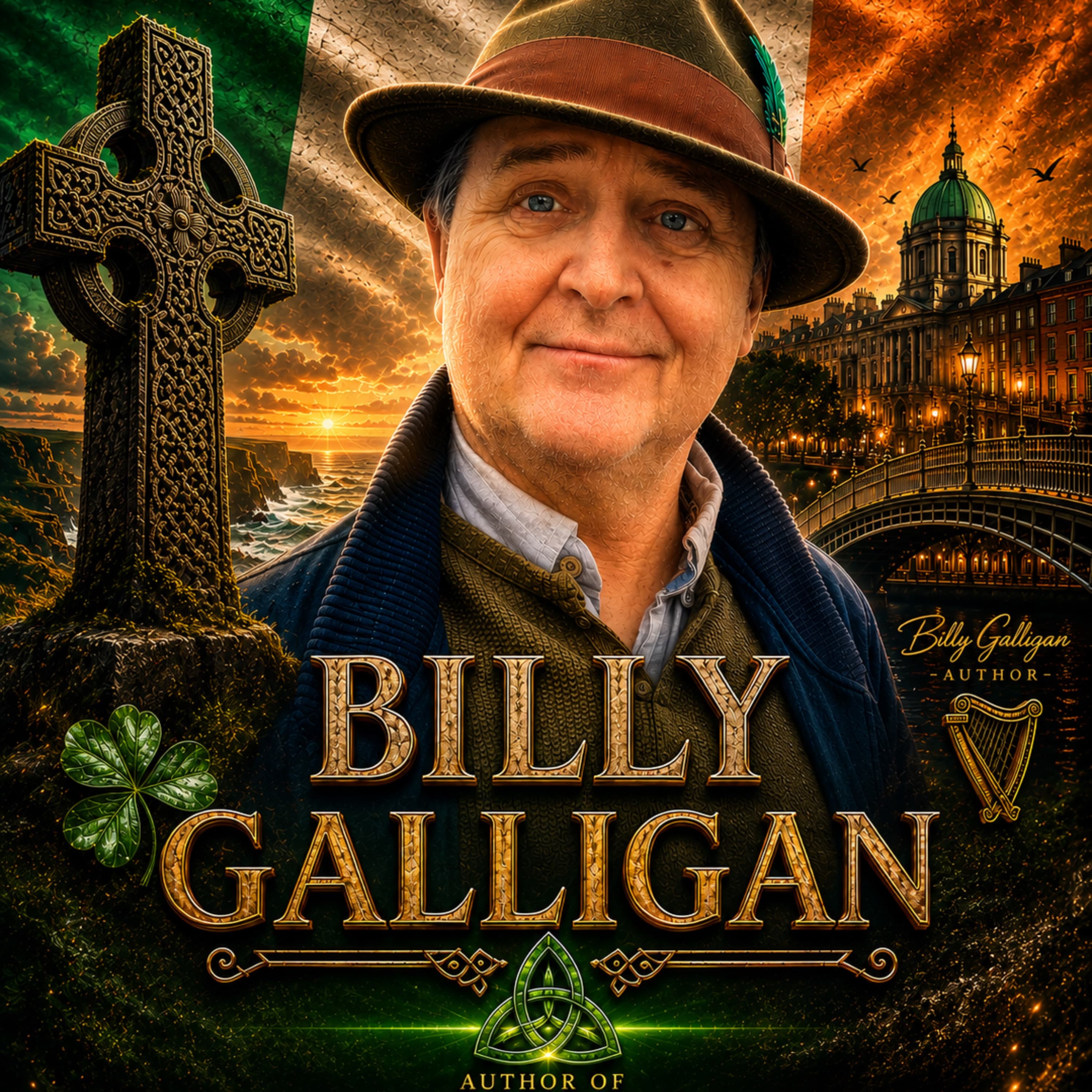


Rails, Resilience, and the Road to Georgia
Billy Galligan shares how early lessons as a porter on Irish trains shaped his patience, diplomacy, and calm under pressure later in life as a bus driver in Georgia. He also reflects on military training, a career-altering injury, and the unexpected path that led him to discover photography.
Chapter 1
The Rhythms of the Rails
Billy Galligan - Author
Hey everyone, welcome to the show! I am Billy Galligan, and before I ever navigated forty feet of yellow steel filled with ninety screaming middle schoolers through the morning traffic of Gwinnett County, Georgia, I learned the rules of the road on a completely different set of tracks.
Billy Galligan - Author
Picture this: it is January 1985. I was just shy of seventeen years of age, wearing a uniform that was slightly too large and smelled of heavy wool and starch. My grand plan of joining the military had been temporarily frozen by a government recruitment freeze, so there I was, standing on the platform at Heuston Station in Dublin, having just landed a job as a Junior Porter with Coras Iompair Eireann -- or CIE, as we all called the lifeblood of Irish transport back then.
Billy Galligan - Author
My very first assignment was the Dublin to Westport line, heading out west. Now, that train was not just a collection of metal carriages; it was a cross-section of Ireland itself. You had farmers in heavy tweed heading home from the Dublin markets, families off on their holidays, and college students crammed into compartments with cardboard boxes and worn suitcases.
Billy Galligan - Author
And let me tell you, as a young lad of seventeen, you learn very quickly that the job of a porter is only about ten percent handling luggage and ninety percent pure observation. You start watching faces. You read the subtle cues. You sense who is anxious about their journey, who needs a helping hand down the carriage corridor, and who just wants a bit of quiet to watch the damp green fields roll past the glass.
Billy Galligan - Author
But the real education happened on those windswept, rural stations in the dead of winter. There would be unexplained delays -- signal failures, engine trouble, or just the unpredictable nature of Irish rail schedules back then. You would find yourself standing on a wet platform in the middle of Mayo, the wind cutting right through you, with fifty passengers looking to you for answers.
Billy Galligan - Author
That is where I learned the fundamental art of patience. You could not rush the signalman, and you certainly could not change the weather. You just had to be a steady presence. It is a lesson that serves me every single day now when I am sitting in the driver seat of my yellow chariot of chaos, waiting calmly for that last little straggler running down the driveway with their shoelaces trailing in the Georgia mud. You have to read those cues, like young Tommy on his first day of elementary school, clutching his oversized backpack like a shield. You look at them and you know exactly how to steady the ship because you spent your youth doing it on the damp platforms of Ireland.
Chapter 2
Diplomacy in the Shadow of the Troubles
Billy Galligan - Author
Eventually, I got promoted to the busier, much more charged Dublin to Belfast line. And if the Westport run was a study in patience, the Belfast line in the late eighties was an absolute masterclass in diplomacy.
Billy Galligan - Author
We have to remember the context here. The Troubles were an undeniable, heavy reality of everyday life. The atmosphere on the train could shift in an instant, depending on who boarded, what news had broken that morning, or even just a sudden security check at the border. As railway staff, we had to be completely neutral, a steady presence in the middle of incredibly tense times.
Billy Galligan - Author
It was not about taking sides; it was about ensuring that everyone in those carriages got to their destination safely. I learned how to navigate highly sensitive conversations, how to de-escalate friction with a quiet, polite word, or sometimes just by changing the subject to something as simple as the football results or the quality of the tea. I learned to listen far more than I spoke, and to choose my words with absolute care.
Billy Galligan - Author
It is funny how those years on the rails shape you. People often look at my twenty-three years in the military and assume all my discipline and calm came from the army. But the truth is, the foundation was laid right there on the trains.
Billy Galligan - Author
When I am driving my Gwinnett County route today, and a backseat squabble erupts between two high schoolers over a missing soccer trading card, or when parents are anxious and demanding answers because a sudden downpour has delayed the route by thirty minutes, I use the exact same diplomacy. You keep your head cool, you speak with quiet authority, and you reassure them. You tell them, you will be grand, and you mean it.
Chapter 3
Shorn Locks and a Shattered Leg
Billy Galligan - Author
By November 1987, the recruitment freeze had finally thawed, and I acted on that lingering itch to join the Irish Defence Forces. But my entry into military life did not exactly go off without a hitch.
Billy Galligan - Author
First off, there was the haircut. Now, I did not expect a styled trim, but this was full-on sheep-shearing in the freezing cold. Any shred of dignity or individuality you thought you possessed was swept up off the concrete floor with the rest of the clippings. We were a bunch of cold, clueless, and absolutely knackered lads from every corner of Ireland, thrown together in basic training. But that is where you make the friendships that last a lifetime -- lads I still keep in touch with today for a good bit of slagging on social media.
Billy Galligan - Author
But just as I was starting to find my feet in the military routine -- boom. Literally. Just before Christmas 1987, we were playing a game of soccer on the parade ground. I went in for a challenge, and I heard this loud crack. It did not come from the ball. It was my right femur snapping clean in two, like a dry breadstick.
Billy Galligan - Author
That put my training on ice for seven grueling months of intense physiotherapy, a lot of stubbornness, and probably a fair amount of swearing. I finally recovered and rejoined the ranks in July 1988, posted to the 2nd Field Artillery Regiment at McKee Barracks in Dublin. I figured I would spend my career learning how to lob artillery shells at unsuspecting hillsides.
Billy Galligan - Author
But then came the administrative twist of fate. A lad in my unit desperately wanted to stay in Dublin, while the army needed someone to swap down to Baldonnel, into the Air Corps. I was the fresh recruit, so they made the swap. At the time, I was gutted to leave McKee. But looking back, it set everything else in motion. A second shot? A life? Sure, why not! That single swap down to the Air Corps opened doors I never knew existed, eventually putting me on a plane to Savannah, Georgia, with the Pipe Band in 2001, where I would meet my wife, Leanne. You think you have taken a wrong turn, and it ends up being the exact road you were meant to travel all along.
Chapter 4
The Accidental Lens
Billy Galligan - Author
Once I arrived at Casement Aerodrome in Baldonnel, amidst the constant roar of turboprops and the highly disciplined movement of the ground crews, I discovered an entirely unexpected calling: photography.
Billy Galligan - Author
It started with basic aerial reconnaissance work. I found I had a real knack for capturing the landscape from a unique aerial perspective. Photography requires an immense amount of focus, an eye for the tiniest detail, and absolute patience while you wait for the light or the angle to be just right.
Billy Galligan - Author
By 2004, I was offered the role of Public Relations Photographer for the Defence Forces. That job cracked my world wide open. I was suddenly traveling the world, capturing official state visits with President Mary McAleese, but also documenting our peacekeeping forces in some of the most challenging environments on earth.
Billy Galligan - Author
People often ask me how a military photographer transitions into driving a school bus in suburban Georgia. But to me, the connection is clear. The photographer is always scanning, always observing the edges of the frame, anticipating the next movement before it happens.
Billy Galligan - Author
When I am behind the wheel of bus 2538, my eyes are constantly moving across those mirrors. I am scanning the traffic patterns, watching the road ahead, and keeping a close eye on the kids in my rearview. It is the exact same discipline, just applied to forty feet of yellow steel instead of a camera lens.
Chapter 5
Band of Brothers in Liberia
Billy Galligan - Author
Of all the deployments I documented, nothing compared to July 2006, when a military journalist and I decided to follow a single section of soldiers from Kilkenny through their entire deployment cycle. We wanted to capture real life in real time. We called them our own Band of Brothers.
Billy Galligan - Author
We rolled into Monrovia, Liberia, right as the 2006 World Cup Final was wrapping up. I remember stepping off the plane onto the hot tarmac just as Zinedine Zidane delivered that infamous headbutt on the television screens in the airport. The locals were crowded around the screens, and we were arriving in convoy into a nation that was desperately trying to heal from years of brutal civil war.
Billy Galligan - Author
Our mission was part of the United Nations peacekeeping effort. And when I say we embedded with those Kilkenny lads, I mean we truly embedded. No special treatment, no shortcutting the hard parts. If they were out on a four-day patrol in the stifling humidity, choked by dust that got into places dust should never go, I was right there beside them, wedged into the back of a hot armored personnel carrier, my camera lens constantly fogging up from the heat.
Billy Galligan - Author
At first, they were understandably cautious of me. Who is this fella with the camera? Is he writing us up for swearing too much? But I did not carry a clipboard; I carried their story.
Billy Galligan - Author
I remember one moment, hours into a brutal patrol, we paused under a crumbling awning to escape the sun. Nobody spoke. The lads just drank their water, checked their gear, and gave me a quiet nod. That nod meant everything. It meant I belonged.
Billy Galligan - Author
The photographs we brought home were not just images of soldiers; they were portraits of raw brotherhood and fragile hope in a country rebuilding itself. Witnessing that kind of true hardship changes how you view the world. It gives you an immense appreciation for the ordinary peace of suburban life. When I am stuck in a traffic jam on Peachtree Industrial Boulevard today, or dealing with a lost lunchbox, I do not get worked up. I just think back to the dust of Monrovia, take a breath, and remember how lucky we are to have these ordinary days.